The problem
This post is also available in:
So once again: War in Europe – for four years already! How is it possible??
Ok, Putin is an autocrat and ultimately does what he wants. If Russia were a democracy, the Ukraine war certainly wouldn’t have happened…
Really?
So how about the POTUS (=President of the United States) sending out “the United States armed forces [to] conduct[…] an extraordinary military operation in the capital of Venezuela” to kidnap the Venezuelan president?
And then to unleash the US Army on Iran, starting a war which has been dragging on for months now as well, without even asking Congress for approval, contrary to the laws in his own country, not to talk about international law?
And this after campaigning for his election with the promise to end wars rather than starting new ones?
Ok, so you might still say, normally these things don’t happen in the free, Western, democratic world…
Really?
Flashback to 2001. On January 1st, George W. Bush became President of the USA. Nine months later, terrorists reduced the World Trade Center to rubble. As a reaction to the attacks, George W. Bush started the war in Afghanistan in 2001, which only ended in 2021 with the chaotic withdrawal from Kabul. More than 100,000 people were killed in the Afghan war between 2001 and 2014. The costs for the USA alone between 2001 and the end of 2019 are estimated at almost one trillion US$.
Not enough, in 2003, George W. Bush began the Iraq war “in violation of international law”. While the war machine was built up over months, the government tried to convince people of the necessity of this “war on terror” by means of – as it turned out later – lies about the existence of weapons of mass destruction in Iraq.
Mass demonstrations against the looming war mobilize millions of people. February 15, 2003 is considered the largest protest event in human history. That weekend alone, between 6 and 10 million people demonstrate in 60 different countries against the looming war.
But Bush, Cheney and Co. were undeterred. The “second Iraq war” claimed up to almost a million lives, and estimated war costs of about 2 trillion dollars on the American side alone.
These examples show: No, it is not only in dictatorships that a few powerful people can wage war on other countries, this is also the reality in democracies!
In fact, it largely doesn’t matter how the powerful came to power. Once they have the power, there is virtually no way even in (indirect) democracies to stop them.
One may debate whether the people in the US might have voted for the Iraq war, were they given the choice. But that is not the point here. The point is that they WERE NOT given the choice. And hence, none of the war decisions mentioned were democratically legitimized in any way! Nobody outside the narrow circle of men in power could actually decide these wars.
You will say that in democracies a war decision has to be made by the parliaments, and they have democratic legitimacy. Also the Iraq war went through US Congress. So in the end, is a war decision in a democracy not automatically democratically legitimized?
Unfortunately no, at least not in the proper sense. Even if parliaments get to vote – which, as we saw, may not even happen. Or only months later, timidly…
In indirect democracies, the people exert their influence by voting between different election programs, parties, or candidates. However, the need for a decision on “military intervention” is typically triggered by an event that occurs after the last election of members of parliament or president. Like the 9/11 attacks in the US. And of course there is no influence of war-triggering events backwards in time on those election programs. At the time of election, the possibility of going to war with Afghanistan or Iraq was not in any election program.
Of course, it is part of everyday life in an indirect democracy that politicians have to deal with problems that arise after the elections. But the severity of a war decision is in particularly blatant contradiction to the strictly vanishing influence of the people – even in genuinely good-willing democracies – and requires additional legitimization.
It is to be feared that the lack of democratic legitimacy in almost all countries contributed significantly to the existence of many wars – and will continue to do so in the future as long as this structural problem in the decision-making chain is not solved.
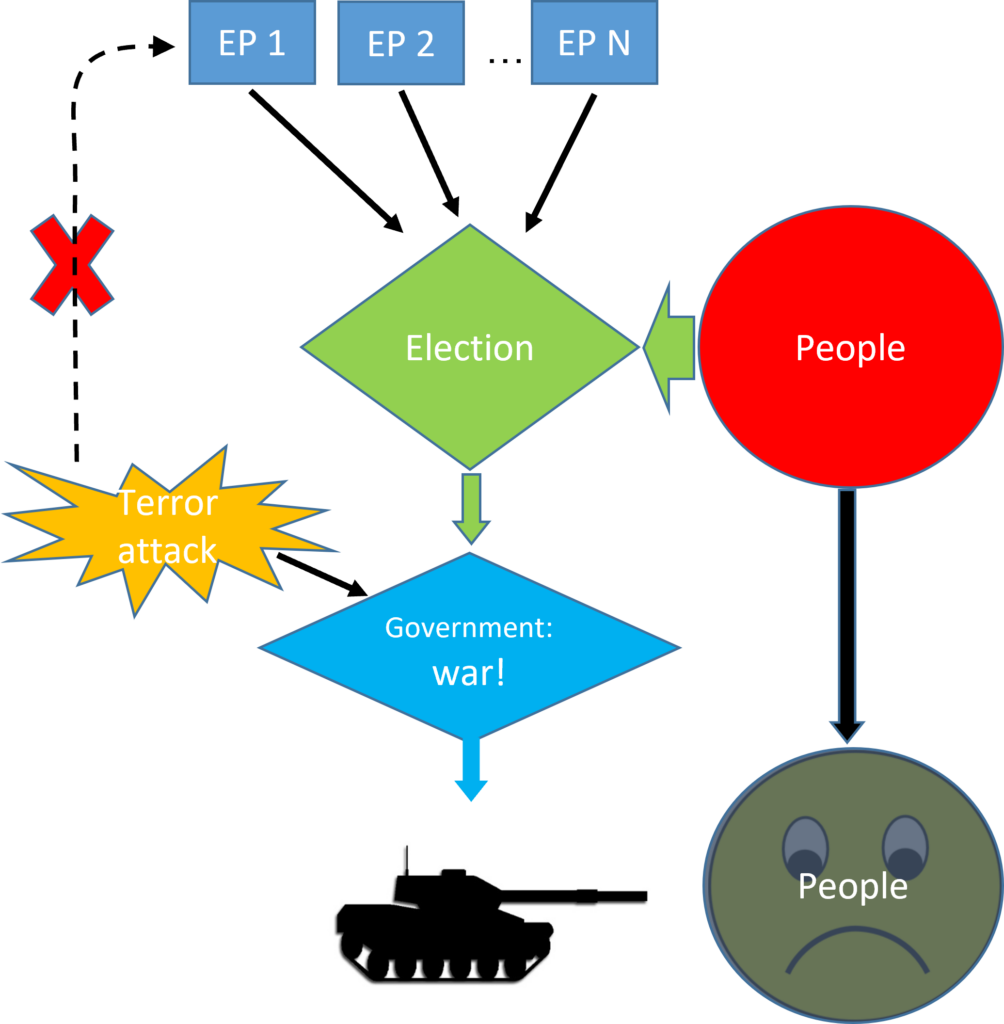
Fig.: The problem
War decisions are often triggered by events that happen while a government is already in place. The question of whether one should go to war or not is hence not part of any election program. Even in a good-willing but indirect democracy, war decisions are therefore typically not democratically legitimized:
Nobody ever asked the people!
And that is still under the assumption that the democratic processes work. Not to talk about PsOTUS, Prime Ministers, and Ayatollahs deciding wars single-handedly as they please once they are in power.
This is the REAL Problem: People of almost all countries have given, voluntarily or not, the power to their leaders to wage war on other people – without any control whatsoever. In the extreme case, when it comes to starting nuclear war, about 7 more or less lunatic/narcissistic/old men have the power to destroy humanity in less than 2 hours.
Of course they wouldn’t…
Really?
Who decided the bombings of Hiroshima and Nagasaki?
Our planet resembles a barrel of gun powder, with some lunatics sitting on it and playing with fire. This is totally insane! Humanity must gain back control over decisions of war before it’s too late and we all get blown up.